RPGT Malaysia Explained: Rates, Calculation and What Sellers Must Know

If you sell a property in Malaysia for more than you paid for it, you may need to pay Real Property Gain Tax (RPGT). In simple terms, it is a tax on the profit — or “gain” — from disposing of certain Malaysian properties, land and, in some cases, shares in property companies.
RPGT is not a tax on the full selling price. It is charged on the gain after taking into account the acquisition price and allowable expenses, and the rate depends heavily on how long you have owned the property and who the seller is.
Who pays RPGT?
RPGT generally applies when you dispose of a chargeable asset in Malaysia, such as a house, shoplot, vacant land, farm or certain shares in a real property company.
The seller — called the “disposer” — can be an individual, company, partnership, trustee or other entity. The buyer also has a role: in a normal cash sale, the buyer must retain part of the purchase consideration and remit it to LHDN within 60 days of the disposal date.
How is the gain calculated?
Think of RPGT as tax on your net profit, not your gross sale price.
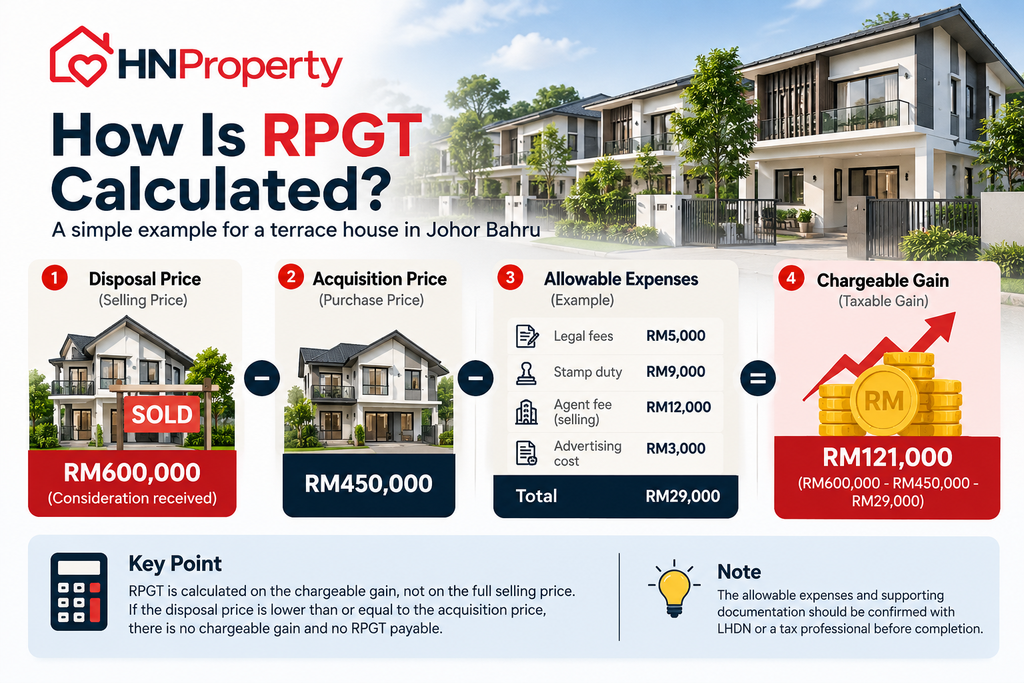
A simplified calculation is: Chargeable gain = Disposal price – Acquisition price – Allowable expenses
LHDN states that the disposal price is the consideration received for the asset, less allowable expenses. If the disposal price is lower than or equal to the acquisition price, there is no chargeable gain. For example, suppose you bought a terrace house in Johor Bahru for RM450,000 and later sold it for RM600,000. If allowable costs such as certain acquisition and disposal-related expenses reduce the taxable gain, the RPGT is calculated on the resulting gain — not on the RM600,000 selling price. The exact allowable items and documentation should be confirmed with LHDN or a tax professional before completion.
Current RPGT rates
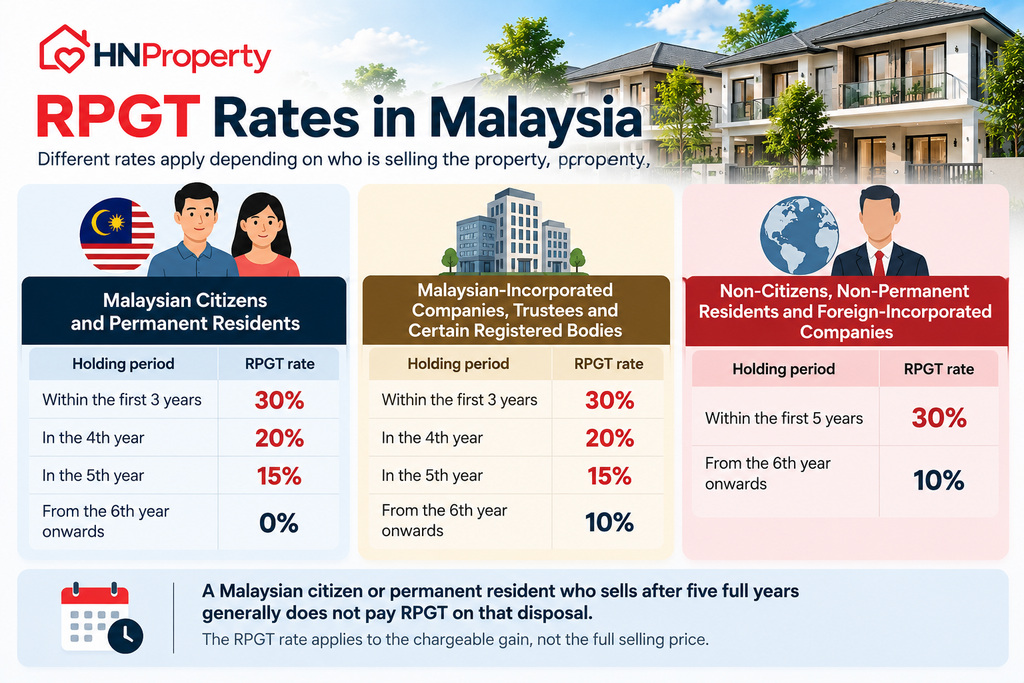
For Malaysian citizens and permanent residents, who sells after five full years generally does not pay RPGT on that disposal.
For Malaysian-incorporated companies, trustees and certain registered bodies, the rate is 30% within three years, 20% in the fourth year, 15% in the fifth year, and 10% from the sixth year onwards.
For non-citizens, non-permanent residents and foreign-incorporated companies, the rate is 30% for the first five years and 10% from the sixth year onwards.
What this means when selling
Timing matters. If you sell too early, RPGT can take a significant bite out of your profit. For instance, a Malaysian citizen selling in the fourth year pays 20% of the chargeable gain, while selling from the sixth year generally means no RPGT.
For financing and resale planning, remember that renovation costs, legal fees, agent commission and loan interest do not automatically reduce RPGT. Only expenses allowed under the RPGT rules can be deducted, so keep complete records from purchase through to sale.
Practical takeaway
Before putting a property on the market, work out two things: your likely net gain and your holding period from the acquisition date. If you are a Malaysian citizen or PR and can wait until after the fifth year, RPGT is generally 0% but do not delay a sensible sale purely for tax reasons if market conditions, financing pressure or personal circumstances say otherwise.
For higher-value transactions, foreign ownership, inherited property, gifted property or company-held assets, get advice from a licensed tax agent or property lawyer before signing the Sale and Purchase Agreement.
Hafiz Noor