
Is Johor building too many data centres?

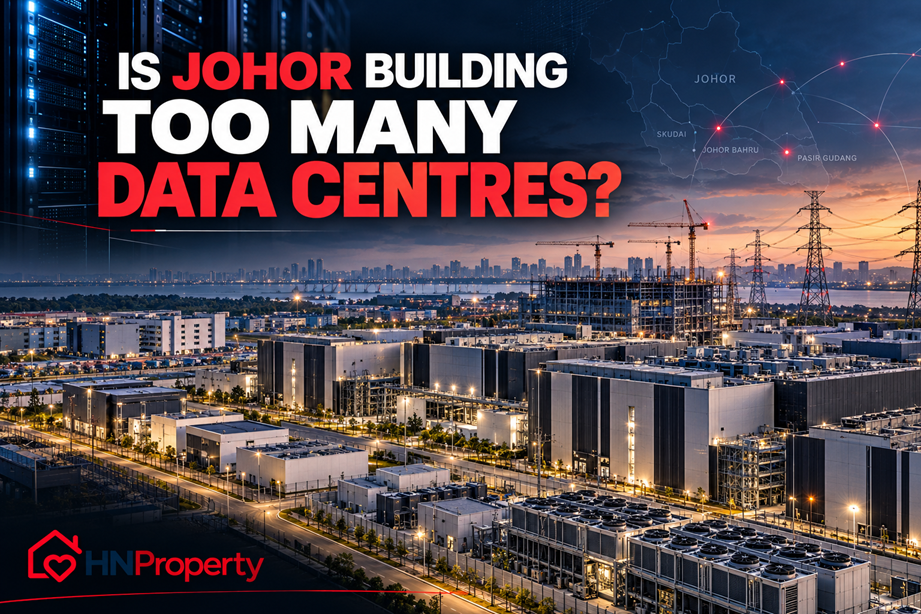
From Sedenak and Kulai to Iskandar Puteri, Kempas and Pasir Gudang, billions of ringgit are being committed to digital infrastructure. At the same time, Johor has started tightening approvals because data centres require substantial amounts of electricity, water and supporting infrastructure. This resulted in Johor reaching the limits of its supporting infrastructure.
1. Johor’s data centre industry has grown very quickly
Johor’s attraction as a data centre location is largely linked to its proximity to Singapore, relatively lower land and operating costs, available industrial land and access to power, water and telecommunications infrastructure.
As of October 2025, the Johor state government reported 48 data centre applications approved, comprising 17 existing data centres, 11 under construction and another 20 approved projects. The reported estimated investment associated with these applications was about RM146.7 billion.
MIDA has also highlighted major data centre investments from international operators including AWS, Microsoft, Google, Bridge Data Centres, DayOne, AirTrunk and Vantage Data Centres. Malaysia recorded RM385.7 billion in data-centre-related investments from 2021 to the first half of 2026, although that figure is for Malaysia as a whole rather than Johor alone.
2. The real constraint: power and water
This is probably the more important issue for Johor’s property market. A data centre is not simply another industrial building. It requires a large and reliable electricity connection, cooling systems, water infrastructure, telecommunications connectivity and backup systems.
Johor’s own data centre planning guidelines specifically address electricity and water requirements.
The state government is already planning a substantial investment to increase water capacity. Johor has identified new and upgraded treatment facilities that are expected to add approximately 1,100 million litres per day (MLD) of treated-water capacity, with projects planned through 2031.
On the electricity side, Wood Mackenzie estimates that Johor’s data centre maximum demand has reached around 3.8GW, equivalent to almost 1.5 times the state’s current electricity demand. It estimates data centres could account for around 40% of Johor’s electricity consumption by 2035 if the current trajectory continues.
3. So, is Johor facing a data centre oversupply?
The evidence does not currently point to a conventional oversupply situation. Knight Frank reported only 0.7% co-location vacancy in Johor, while Fitch Ratings said it did not see an immediate oversupply risk for Malaysia’s data centre sector. Fitch also noted that Johor’s facilities can potentially serve cloud and AI demand, giving them alternative uses if the pace of AI-related demand changes.
This explains why Johor has become more selective. The state’s planning guidelines generally direct data centres towards commercial or industrial planning zones, while the approval process involves technical and planning considerations. At the national level, the Data Centre Task Force has also moved towards approving projects with secured power and water resources and demonstrable green compliance.
Practical Takeaway
For Johor property, the data centre story is therefore becoming an infrastructure and location story, with the boom attracting major capital and accelerated industrial development. But as the pipeline gets larger, access to electricity, water, connectivity and supporting infrastructure will increasingly determine which locations can actually benefit from the next stage of Johor’s digital economy.
Hafiz Noor