Why Debt Service Ratio (DSR) Matters for Your Home Loan Approval

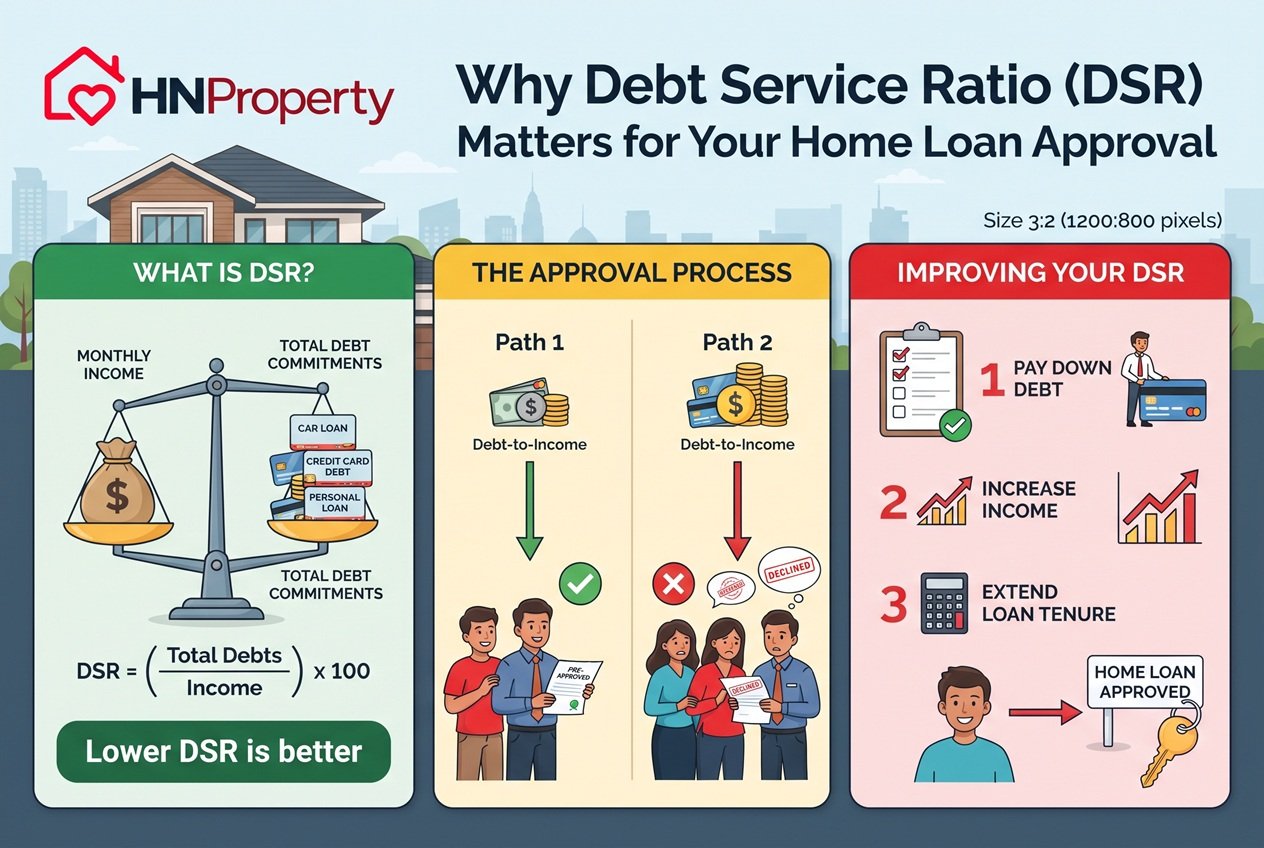
Before a bank approves your home loan, it wants to answer one simple question: can you comfortably repay it every month? That is where your Debt Service Ratio (DSR) comes in. It is one of the first numbers banks check when you apply for a housing loan or Islamic home financing in Malaysia.
DSR is not about whether the property is a good investment. It is about whether you can afford the monthly repayment after your existing commitments.
What is DSR?
DSR compares your total monthly debt repayments with your monthly net income — the salary you take home after EPF, SOCSO and tax deductions.
The basic formula is: DSR = (Total monthly debt commitments \ Net monthly income) x 100
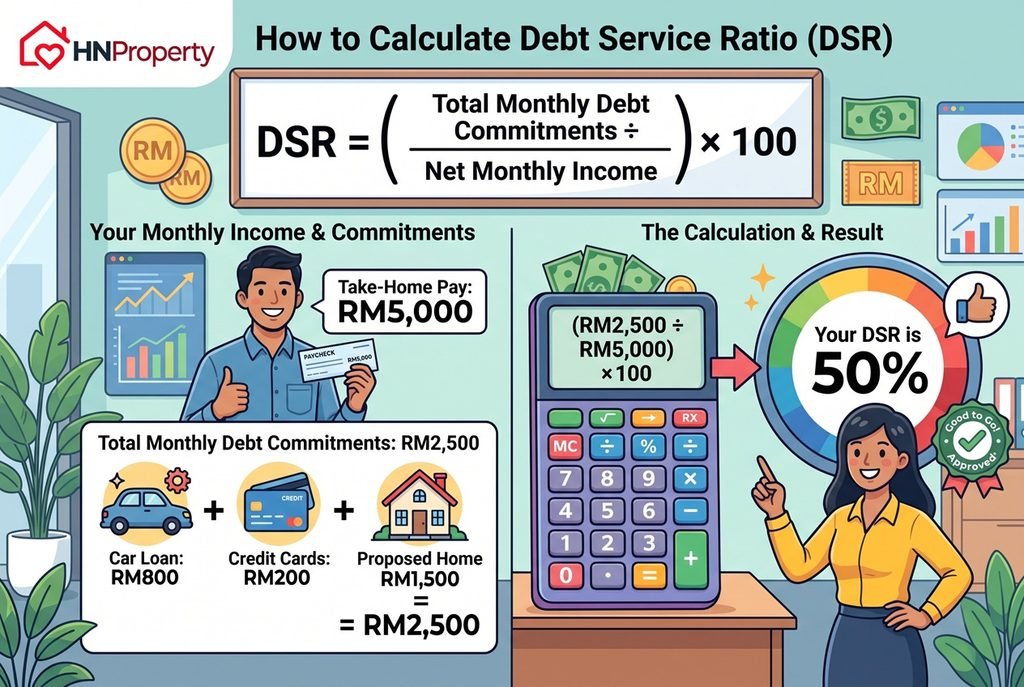
For example, if your take-home pay is RM5,000 and you pay RM800 for a car loan, RM200 in credit card minimum payments and RM1,500 for the proposed home loan, your total commitments are RM2,500. Your DSR is 50%.
Banks generally include car loans, personal loans, PTPTN, credit card minimum payments and certain non-bank instalments in the calculation. PIDM notes that banks commonly accept a DSR below 60%, although each bank applies its own internal policy and may consider other factors such as income stability and credit record.
Why banks care about DSR
A home loan is usually a long commitment, often spanning decades. If too much of your income is already committed to debt, the bank sees a higher risk that you may struggle to repay if interest rates rise, your income drops or unexpected expenses appear.
A lower DSR gives you more breathing room for daily living costs, family expenses, savings and emergencies. Bank Negara Malaysia’s Financial Stability Review reported a median DSR of 41% for newly approved household loans in the first half of 2025, showing that lenders generally assess affordability carefully before approving new borrowing.
In practical terms, a high DSR does not always mean automatic rejection. The bank may:
- Approve a smaller loan amount.
- Ask for a larger down payment.
- Request a joint borrower or guarantor.
- Ask for more income documents.
- Decline the application.
This is why two buyers looking at the same RM500,000 terrace house in Johor Bahru may receive very different loan offers. A buyer with low existing debt may be approved comfortably, while another with a car loan, PTPTN and several credit cards may need to adjust the purchase price or financing structure.
What is a healthy DSR?
There is no single DSR percentage that guarantees approval across all banks. However, a useful guide is:
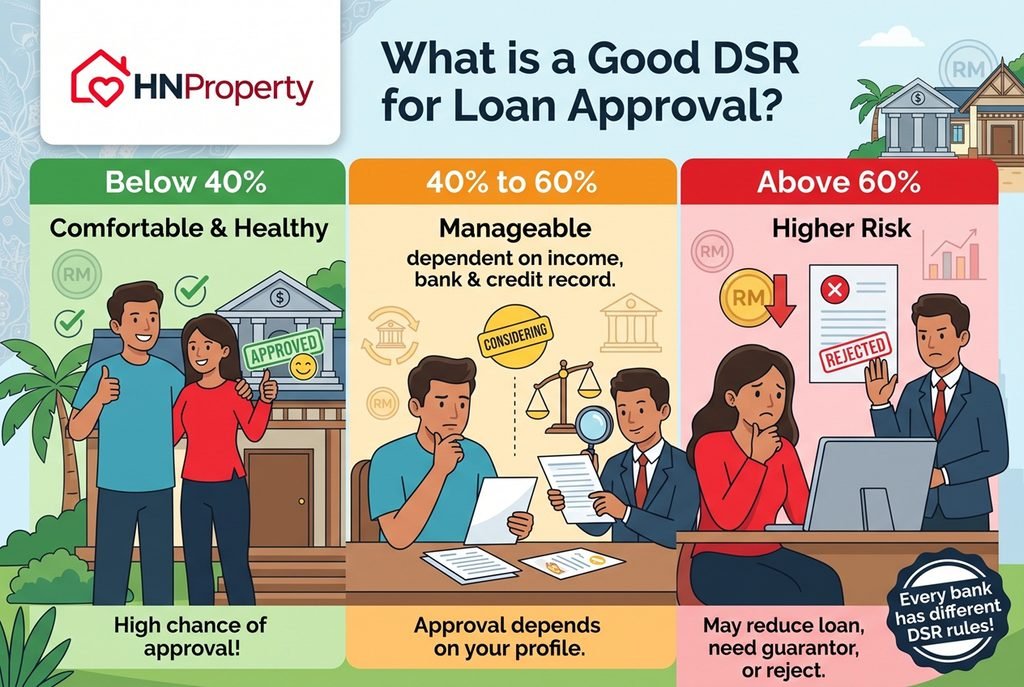
PIDM advises maintaining DSR between 30% and 40% where possible, because it leaves more disposable income after debt repayments. CIMB similarly describes below 60% as the level most banks prefer, while noting that some lenders may accept higher DSR depending on their own affordability assessment.
Remember: being eligible for a loan does not always mean it is genuinely affordable for your lifestyle. A bank may approve you at 60% DSR, but that could leave little room for petrol, tolls, groceries, insurance, children’s expenses and savings.
How to improve your DSR
If you plan to buy a home in the next six to 12 months, prepare early.
- Clear or reduce short-term debt. Settle credit card balances, BNPL instalments and small personal loans where possible.
- Avoid new commitments. Do not take a new car loan, personal financing or large instalment plan shortly before applying for a housing loan.
- Pay on time. Your repayment record matters alongside DSR; late payments can weaken your application.
- Keep income records ready. Salaried buyers should prepare payslips, EPF statements and bank statements. Self-employed buyers should keep consistent bank statements, invoices and tax records to show stable income.
- Consider a joint borrower. Combining income with a spouse or family member may improve affordability, but both parties become responsible for the financing.
For example, a buyer earning RM6,000 net monthly with RM1,000 in existing commitments has RM2,000 of monthly repayment capacity before reaching a 50% DSR. If the bank’s assessment allows a 60% DSR, the maximum total commitments may be around RM3,600 — but that does not mean the buyer should borrow to that limit.
Practical takeaway
Before you fall in love with a property, calculate your DSR first. Add up every monthly commitment, including the estimated home loan instalment, then divide it by your net monthly income.
A safer target is to keep your total DSR below 40% to 50%, even if a bank may consider applications above that level. This gives you a better chance of approval and, more importantly, protects your cash flow after you move in.
If you are buying in Johor, factor in the full monthly cost of ownership — not just the loan. Maintenance fees for stratified properties, quit rent, assessment rates, insurance, commuting costs and potential interest-rate changes should all fit within your budget. DSR helps you get approved; sensible budgeting helps you stay financially comfortable.
Hafiz Noor