
Rental Deposit: How Much Do You Need to Prepare?

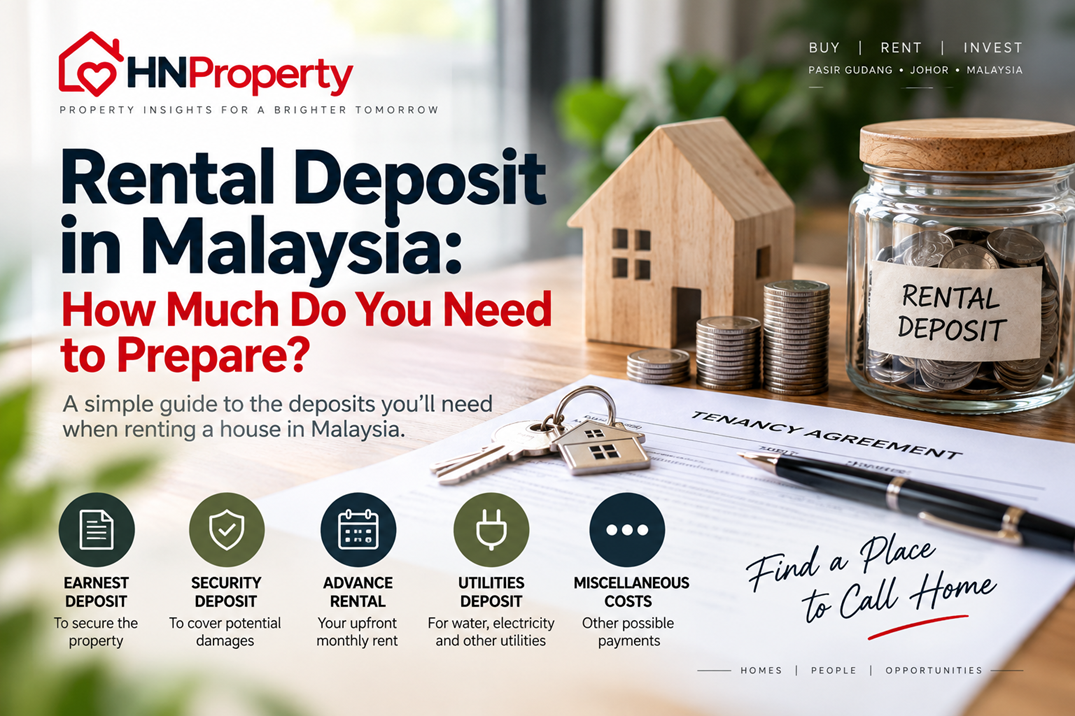
You’ve found a house you like. The monthly rent is RM2,000, and you’re ready to move in.
Then the agent says: “You need 2 + 1 + ½.” Suddenly, RM2,000 rent does not mean you only need RM2,000 to move in.
For many first-time tenants, the confusing part is not just the amount. It is understanding what each payment is actually for, which amounts are refundable, and what happens to your money when the tenancy ends.
Here’s a practical guide to rental deposits in Malaysia and how much money do you normally need upfront?
| Payment | Typical amount | Purpose | Usually refundable? |
|---|---|---|---|
| Earnest / booking deposit | ½–1 month rent | Reserves the property | Depends on agreement |
| Security deposit | 2 months’ rent | Protects landlord against rent arrears, damage or breach | Yes, less legitimate deductions |
| Advance rental | 1 month rent | Pays the first month’s rent | No — it is rent |
| Utilities deposit | ½ month rent | Covers outstanding utility bills | Yes, less outstanding bills |
| Miscellaneous deposits | Varies | Access cards, car park, keys, etc. | Depends on the item and agreement |
The commonly quoted “2 + 1 + ½” means: 2 months security deposit + 1 month advance rental + ½ month utilities deposit.
That works out to 3.5 months of rent upfront.
For a property renting at RM2,000 per month:
- Security deposit: RM4,000
- Advance rental: RM2,000
- Utilities deposit: RM1,000
- Total: RM7,000
The important point is that there is no statutory standard deposit amount for residential tenancies. The amount and refund arrangements are primarily determined by the tenancy agreement, so you should not assume that every property will use exactly 2 + 1 + ½.
- Earnest Deposit / Booking Deposit
The first payment is the earnest deposit, sometimes called a booking deposit. Its purpose is to reserve the property for you while the tenancy agreement is being prepared. This sum is part of the total deposit.
The offer letter however will indicate if the landlord decides not to proceed, the earnest deposit will be refunded. In many arrangements, the earnest deposit is subsequently converted towards the total rental deposit.
- Security Deposit
The security deposit is the main financial protection given to the landlord during the tenancy. A common amount is two months rent, however if the unit is fully furnish with a lot of appliances, the landlord may request up to 3 months security deposit.
The security deposit is generally intended to protect the landlord against matters such as:
- unpaid rent;
- damage caused by the tenant beyond normal wear and tear;
- other breaches of the tenancy agreement; and
- other sums which the tenancy agreement expressly allows the landlord to recover.
At the end of the tenancy, the landlord should account for any deductions made from it according to the tenancy agreement and the actual circumstances. If you finish tenancy with no outstanding rental, damage then there will be no basis for a deduction.
This is why photographs and videos at the beginning and end of the tenancy are extremely useful.
- Advance Rental
Advance rental is often confused with a deposit. For example, your tenancy starts on 1 October and you have paid October’s rent in advance, that RM2,000 is payment for your October occupation.
The following month rental is usually stated in the tenancy agreement being seven days after the due date.
- Utilities Deposit
The utilities deposit is intended to protect the landlord against unpaid utility charges at the end of the tenancy.
A common amount is around half a month’s rent, although the actual amount can vary. The important distinction is the utilities deposit is not there for you to use to pay your ordinary monthly electricity or water bills.
Instead, it acts as a buffer in case there are outstanding amounts when you leave. This is why taking final meter readings and keeping your final utility payment records is a good practice.
- Miscellaneous Deposits: Access Cards, Car Parks and Keys
There may also be smaller deposits which do not form part of the traditional 2 + 1 + ½ arrangement.
For example:
- access card deposit;
- car park access card;
- remote control;
- mailbox key;
- house keys;
- parking sticker;
- security tag; or
- other items belonging to the property or building management.
The amount can vary considerably depending on the property and management body. When you return the items at the end of the tenancy, check whether the relevant deposit is refundable because some deposits may be paid to the landlord while others may be payable directly to the management office.
So if you decide to proceed with renting the unit, before paying, always ask for the complete payment breakdown in writing — including the booking deposit, security deposit, advance rental, utilities deposit and any additional charges.
Hafiz Noor